Felled and forgotten? Five years on from Edward Colston

On June 7 2020, the statue of Edward Colston, well-known Bristolian merchant and enslaver, was pulled off his plinth, rolled to the edge of Bristol docks, and pushed into the waters below by Black Lives Matter (BLM) activists. TV and phone cameras relayed the moment to millions of viewers at home – few forget the image of Colston coming down. But fewer recall what happened next…
Five years on, it's a fitting moment to follow Colston’s fate, and to reflect on the wider conversations about our national history – about the figures we look up to, the stories we remember and forget – that he started. What happened after Colston came down? Where’s the statue now? And, most importantly, where should it go next?
Setting the scene for 2020
Edward Colston (1636-1721) was a key figure in the Royal African Company (RAC), a company that traded in gold, ivory, and enslaved people. Joining as a shareholder, Colston became Deputy Governor in 1689 – at a time when the company enjoyed a monopoly on English trade with Africa. During the late 1600s, the RAC shipped around 84,000 enslaved adults from Africa to the Americas with ‘RAC’ branded on their chests. The conditions on these crossings and the plantations were utterly brutal, and historians estimate the company caused the deaths of 19,000 men, women, and children. It was one of the biggest traders in enslaved people in British history – and the profits were highly lucrative for its Deputy Governor.
During his lifetime and in his will, Colston reinvested part of his fortune into schools, hospitals, and alms houses in London and his native Bristol. After his death, it was this (rather than his role in the Trade or where his money came from) that he was remembered for. Colston had schools, streets, and buildings across Bristol dedicated in his honour, and in 1895 – 174 years after his death – Bristol benefactors erected his imposing bronze likeness in the city centre. The statue was meant to be something to quite literally look up to: according to a local newspaper, to ‘encourage the citizens of today to emulate Colston’s notable example’. Not everyone agreed.
Some Bristolians had always challenged Colston’s charitable legacy. As early as 1921, a local reverend referenced Colston’s role as an enslaver, and in 1998 a protester scrawled ‘fuck off slave trader’ across his statue. At the time, both moves were considered subversive. In 2015, a newly-formed ‘Countering Colston’ campaign proposed a revised statue plaque, which would acknowledge his responsibility in the Trade. Ultimately, this was rejected by Bristol City Council – but the movement was gathering steam. In 2018, a Bristol MP called for the statue’s removal, and the same year, Colston Primary School governors, staff, and parents voted to become ‘Cotham Gardens Primary School’. More Bristolians started to challenge Colston’s legacy, and in 2020, these conversations came to a head.
After the May 2020 murder of George Floyd, statues like Colston’s became flashpoints for conversations about historical racial injustice and its powerful current legacy. They also became targets. An online petition to remove Colston grew rapidly: rising from 500 signatures on 1 June to 10,000 by 6 June. On 7 June, some protesters took matters into their own hands. During an organised BLM protest, a small group pulled the statue down with ropes and spray-painted it with expletives as the crowd cheered. They then rolled it half a mile through the streets of Bristol, and dumped it into the harbour. 125 years after it was first erected, Colston’s statue came down. A man – and a powerful myth – had been felled.
What happened after Colston came down?
The statue’s toppling met some heated backlash. Many politicians condemned the fact it had been removed outside the law. Then Home Secretary, Priti Patel, described it as an act of ‘disgraceful’ public disorder and vandalism. Prime Minister Boris Johnson also weighed in with more fundamental criticism. According to him, it wasn’t only illegal but historically incorrect: he wrote on X that ‘We cannot now try to edit or censor our past’. (As any history student knows, statues say more about who we choose to honour in our public places than an objective ‘past’. Otherwise, we’d have to erect statues for every dead historical figure.) Meanwhile, Colston was quietly fished out of the harbour and transferred to City Council storage.
But most of the public reaction was positive, in Bristol and beyond. For the ‘Countering Colston’ campaigners, the toppling was a clear victory. For many Black Bristolians it was especially significant: historian David Olusoga described his relief and sense of recognition when Colston came down. In the months after, Bristolians voted for ‘de-Colstonisations’: Colston Hall became Bristol Beacon, Colston’s Girls School became Montpelier High, and Colston Tower was renamed Beacon Tower. And similar conversations about British history, the people we remember in public places and how this reflects our shared values, were repeated around the country. By the end of 2020, 130 councils had reviewed street names, statues, schools, plaques, and other memorials honouring former enslavers or colonialists (70 of these were revised in some way).
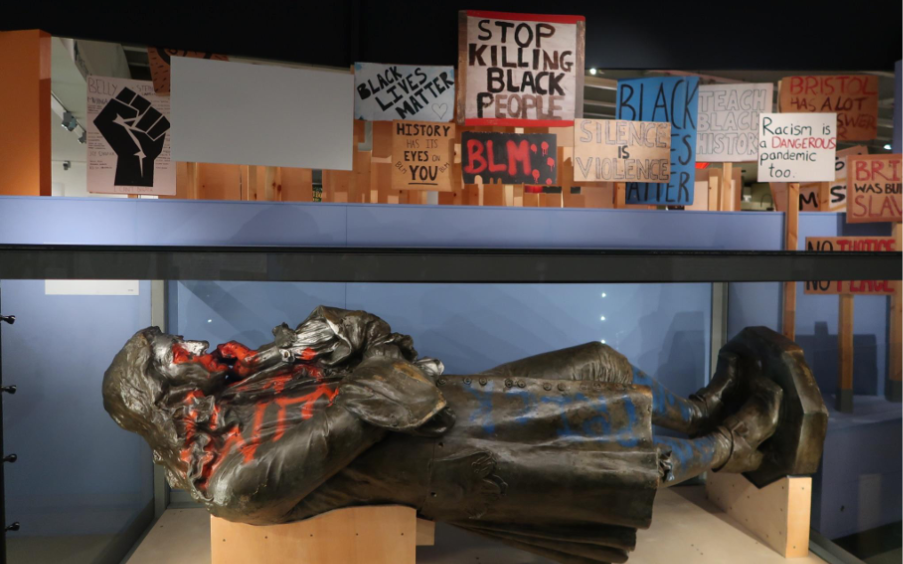
In June 2021, a year after it came down, Colston’s statue entered a temporary summer exhibition at the M Shed Museum in Bristol. Rather than upright, as it had stood for over a century, it was displayed on its side and on the ground, as it was felled in 2020. Curators kept the statue’s graffiti and surrounded it with protest placards from that day, too, to reflect the layers of history added since it was put up (and the different meanings we attach to it today). Above all, the exhibit was designed to be discussed. Titled ‘The Colston Statue: What Next?’, it was part of a project by the ‘We Are Bristol’ History Commission to ask Bristolians what should happen to the statue after the summer, when it quietly returned to City Council safekeeping.
Where is Colston’s statue now?
After an almost three-year viewing break, Colston’s statue made its way back to M Shed. In February 2024, it entered the museum’s permanent collection – where four in five Bristolians said it belonged. It was displayed as part of an exhibit on the history of Bristol protest, stretching from the anti-Corn Laws riots to the segregated bus boycotts, intended to place the BLM protests within the rich tradition of resistance in the city. Part of its wider story. Like in the temporary exhibition, the statue was displayed graffitied, on its side, on the ground, and surrounded by BLM placards – five out of six Bristolians agreed with this choice. It’s still in the protest exhibit today, and this is where I visited it in October (2025).
It’s a thoughtful and thought-provoking exhibit. The section around Colston is designed to recreate the wider conversations about the statue: the original plaque, glorifying Colston as city benefactor, is placed next to the one proposed in 2018, recognising Colston as enslaver. The quotes of Boris Johnson criticising the toppling are placed next to those of campaigners and historians like Olusoga celebrating it. And, rather than allowing passive viewing, it prompts visitors to consider and contribute their own perspective. Before leaving you’re asked to leave Post-it note feedback (‘How did we do? What would you like to see mentioned?). It’s also free. Overall, it’s a great exhibit – but, fundamentally, it’s opt-in.
Though Colston is in a public museum, he’s no longer a part of our public-facing history – in the purest, everyday, shared sense. The M Shed is well known in Bristol, but, as it’s just outside the city centre, you have to plan a visit. Only people who actively choose to find Colston’s statue will. For these people (history nerds like me), it’s easy to visit Colston on a one-off, and to forget about the statue and the important conversations it raises soon after. When I visited my extended family in Bristol, like many Brits, they didn’t recall what had happened to Colston after 2020 – they remembered him coming down, but not what happened to him next. Tucked in a corner of the M Shed, Colston risks slipping from our shared memory, and the wider conversations he raises risk losing steam, too.
Around Bristol, you can still find streets and buildings quietly honouring Colston. A Street, Avenue, and Parade still bear his name, as does an NHS clinic called Colston Fort. In Armoury Square, you can allegedly still find his bust, and elsewhere, other controversial figures are still honoured. Despite nearly 200,000 signatures calling for its removal, for example, the statue of Cecil Rhodes (one of the most committed imperialists in British history) stands in pride of place at Oriel College, Oxford. And despite what seemed like a genuine turning point in 2020, teaching secondary students about the Transatlantic Trade or colonialism is still optional. Opportunities for public, shared discussion about our national history – like the ones we had when Colston came down – seem more important than ever.
What should happen to Colston’s statue next?
Bristol-born Banksy has a powerful alternative vision for Colston’s statue. He suggests we reunite the figure with its plinth in the city centre, but that we re-erect it halfway and surround it with bronze protest figures pulling him down. Frozen at the flashpoint of 7 June. Like the museum exhibit, his idea no longer honours Colston; unlike the exhibit, it has the benefit of returning the figure to the public space. Though a statue alone might not reignite the important, unfinished conversations about our national history and memory, it might make them harder to forget (and as the protesters knew, a statue is a powerful image).
120 years after it was erected, it’s clear Colston’s statue shouldn’t stand upright in Bristol centre. This isn’t a figure most Bristolians want to look up to. But, in 2025, it isn’t clear the best place for it is an exhibit, either. Here, Colston risks being felled, and forgotten – and the important conversations he embodies also risk slowing.
In October, Warwick professor Gary Watt gave a great lecture arguing we should re-erect Colston à la Banksy. He said that without ongoing public engagement, “museums risk becoming mausoleums” – I’d add that ‘movements risk becoming moments’ too. Five years on, it seems time to ask Bristolians again: should Colston come back out?
Bibliography
Primary sources:
Banksy, ‘What should we do with the empty plinth in the middle of Bristol?’, Instagram post, 9 Jun 2020 <https://www.instagram.com/p/CBNmTVZsDKS/> [Accessed 30 Oct 2025]
Edward Colston - Timeline of Dissent and Protest: 1920 to 2020 (2021), Bristol Radical History Group <https://www.brh.org.uk/site/wp-content/uploads/2021/06/Timeline-of-protest-concerning-Edward-Colston-from-1920-to-present-v2.pdf> [Accessed 9 Oct 2025]
Johnson, Boris, ‘We cannot now try to edit or censor our past’, X social media post, @BorisJohnson, 12 Jun 2020 <https://x.com/BorisJohnson/status/1271388182538526721> [Accessed 30 Oct 2025]
National Curriculum in England: History Programmes of Study, Department of Education, Gov.co.uk <https://www.gov.uk/government/publications/national-curriculum-in-england-history-programmes-of-study/national-curriculum-in-england-history-programmes-of-study> [Last accessed 12 Dec 2025]
Patel, Priti, ‘Toppling Edward Colston Statue ‘Utterly Disgraceful ’, Sky News interview, 7 Jun 2020 <https://news.sky.com/video/priti-patel-toppling-edward-colston-statue-utterly-disgraceful-12002452> [Accessed 15 Nov 2025]
Protest display, M Shed Museum [Visited 26 Oct 2025]
Remove the Edward Colston Statue from Bristol City Centre, 38 Degrees.co.uk, <https://you.38degrees.org.uk/petitions/remove-the-edward-colston-statue-from-bristol-city-centre> [Last accessed 12 Dec 2025]
Rhodes Must Fall 2.0 - Oriel College to take down the Cecil Rhodes Statue, Change.org, <https://www.change.org/p/oriel-college-rhodes-must-fall-2-0-oriel-college-to-take-down-the-cecil-rhodes-statue> [Last accessed 12 Dec 2025]
Ross, Alex, ‘Watch: Toppled Edward Colston Statue Dumped in Harbor’ (2020), Bristol Post Live, <https://www.bristolpost.co.uk/news/bristol-news/watch-toppled-edward-colston-statue-4202068> [Accessed 20 Nov 2020]
The Colston Statue: What’s Next? ‘We Are Bristol’ History Commission Full Report (2022), We Are Bristol History Commission, <https://www.bristol.gov.uk/files/documents/1825-history-commission-full-report-final/file>
Western Daily Press, 14 November 1895, p. 6, as in Kuhn, Philip, ‘Who Owns Colston?’ (2020), Bristol Radical History Group, <https://www.brh.org.uk/site/articles/who-owns-colston/#who-owns-colston> [Accessed 20 Oct 2020]
Secondary sources:
Callaghan, Eleanor, ‘Colston’s Toppling Five Years On’ (2025), History Workshop <https://www.historyworkshop.org.uk/museums-archives-heritage/colstons-toppling-fiveyears-on/> [Accessed 20 Oct 2025]
Countering Colston, ‘Where is Colston (Still) Celebrated?’ (n.d), Countering Colston <https://counteringcolston.wordpress.com/who-celebrates-colston/> [Last accessed 12 Dec 2025]
McConnell Simpson, Helen, ‘New display at M Shed: the toppling of the Colston statue’, BristolMuseums.org <https://www.bristolmuseums.org.uk/blog/new-display-at-m-shed-the-toppling-of-the-colston-statue/ [Accessed 10 Oct 2025]
Mohdin, Aamna, and Storer, Rhi, ‘Tributes to slave traders and colonialists removed across the UK’, (2021), The Guardian, <https://www.theguardian.com/world/2021/jan/29/tributes-to-slave-traders-and-colonialists-removed-across-uk> [Accessed 20 Nov 2025]
Nasar, Saima, ‘Remembering Edward Colston: histories of slavery, memory, and black globality’, Women’s History Review, 29(7) (2020), pp. 1218–1225
Olusoga, David, ‘I shared my home with Edward Colston for more than 20 years. Good riddance’ (2020), The Guardian <https://www.theguardian.com/world/2020/jun/11/i-shared-my-home-with-edward-colston-for-more-than-20-years-good-riddance> [Accessed 11 Oct 2025]
Watt, Gary, ‘Moving Statues and Social Movements - Free Speech Acts and the Colston Case’, Culture Wars: Power, Censorship, Freedom (Lecture Series), Warwick University [Delivered 13 Oct 2025]


Comments