What the Walls Knew
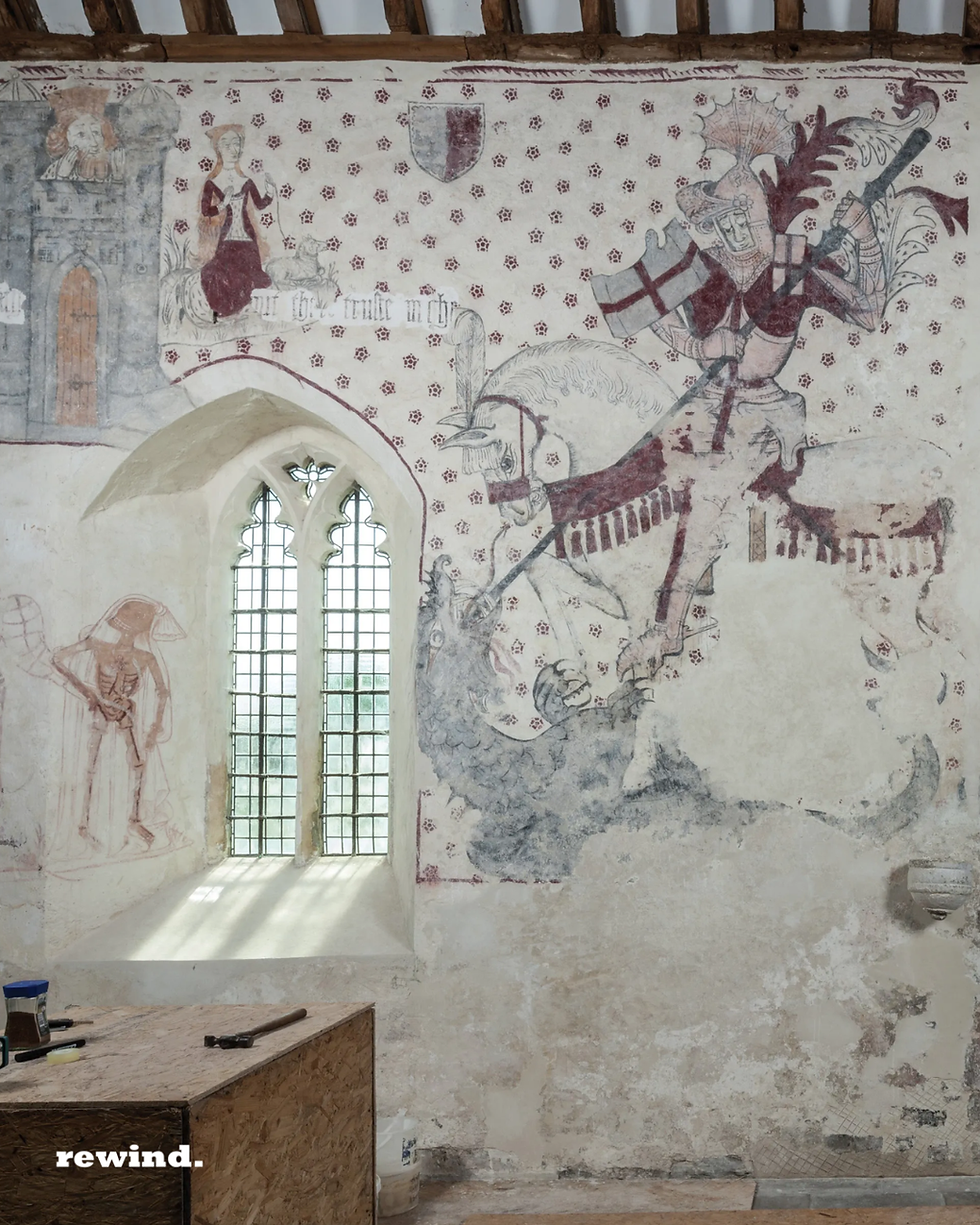
A short piece of historical fiction set in Reformation-era Suffolk, following Thomas, an illiterate wool merchant, as he confronts the whitewashing of his parish church’s medieval wall paintings under royal commission.
---
Thomas could not read. He had never thought of this as a lack until the year the paintings came down.
He was forty-three, a Suffolk wool merchant, and he had managed a household, negotiated with suppliers, raised five children, and buried two of them, all without letters. The world he moved through was not a world of texts. It was a world of faces, seasons, the smell of rain on the old Ipswich road, the sound of the church bell that told you when to stop and when to begin. He had learned to grade a fleece by touch before he was twelve – the drag of a good long staple between thumb and forefinger, the lanolin warmth of it, the faint resistance that told you the crimp was sound. A poor clip felt almost dry, almost defeated, and his hands knew the difference before his mind had time to form an opinion. This was not, as far as Thomas understood, a lesser form of knowing. It was simply the form available to him, and it had served.
The landscape he moved through daily was also a kind of text. The flat clay fields east of the village, the willows hanging over the River Brett in their particular August exhaustion, the enormous Suffolk sky, so wide and so pale it seemed less like weather than like the inside of something, all of it he read without effort. He knew which fields ran wet in autumn by the colour of the grass in June. He knew the east wind off the North Sea by the way it found the gaps in his coat, colder and more purposeful than the south wind, which came in soft and smelled of nothing much. He had never needed letters. God, as he had always understood him, did not require them.
The paintings in the nave of St Andrew’s had been there longer than anyone living could remember. Along the north wall, a sequence of scenes he had known since childhood: the Annunciation, Gabriel’s wings tilted at an angle that always seemed to him effortful, as though he had just landed; the Nativity, the ox’s breath rendered in pale brushstrokes above the manger; the Crucifixion, Christ’s face turned slightly to one side, eyes not quite closed. On the east wall above the chancel arch, a Last Judgement: souls rising or falling, the saved rendered in the same ochre pigment as the damned, only their posture different. Rising or falling. He had spent years reading that distinction.
He could not have told you what theology underlay any of it. He could not have quoted Augustine or debated the question of intercession. But he knew the Annunciation the way he knew his own doorway: by feel, in the dark, without thinking. He had stood beneath it when his daughter Agnes was christened. He had stood beneath it when Agnes died. Both times, Gabriel’s wings had been tilted at that same effortful angle, and it had seemed to him that this was the point: that the holy things did not move or change, that you brought your grief to something permanent, and it held the weight.
---
The commissioner arrived in March, on a morning when the east wind had been blowing for three days straight. Thomas was crossing the churchyard when they rode in. He had a length of cloth to deliver to the curate, a small debt of business. As they came through the lychgate, he stopped and watched.
The commissioner was perhaps fifty, with a long dry face and the kind of stillness that belongs to men who have learned to be careful with words. He wore good wool. Thomas priced it without thinking, Kentish probably, well-fulled, not cheap. He carried a leather satchel under his arm, held close, as though it contained something that might be disputed. His horse was a good bay gelding, mud-splashed to the hocks from the road. Behind him came two clerks on cheaper animals, their faces closed against the cold.
The commissioner did not look at Thomas. He looked at the church tower, then at the porch, then spoke briefly to one of the clerks and went inside. The clerks waited. One stamped his feet. The other had a document on his knee and read it with small, concentrated movements, checking a list. The sky above them was the flat, sealed grey of a Suffolk winter afternoon, the kind that admitted no argument. Thomas stood in the churchyard for a while, the cloth under his arm, and then went home without delivering it.
He learned what had been said from the curate that afternoon. The curate, a young man from Cambridge, precise in his preaching, who smelled faintly of the new printed books stacked beside his desk, stood in the nave and explained what was to happen. The images, he said, were idols. Not in intention, perhaps, but in effect. The people had been venerating paint. They had been kneeling to pigment and plaster. The Word of God was sufficient, and the Word had been made available to them. He gestured to the Bible now chained in the chancel, the great English Bible placed there by the Archbishop’s order. They need not look to pictures for what Scripture could supply.
Thomas looked at the chained Bible. He could not read it.
He said nothing. This did not seem to him to be the moment for saying something. He walked home along the lane that ran beside the glover’s yard, past the pond where the ducks were loud in the grey afternoon and told his wife Margaret what had been said.
Margaret was at the table with the household accounts spread before her. She kept the accounts, read him the figures each month in a voice without reproach. She looked up at him and listened carefully, her pen still in her hand. When he had finished she said, ‘well, it must be as the commissioners direct’. And then, after a moment, ‘it will be strange at first’. And then she went back to her figures. Margaret could read; she had her letters from her father, a clerk in Bury St Edmunds, and owned a small English psalter she consulted in the evenings beside the fire with what seemed to Thomas a kind of quiet sufficiency, as though the book were a door she could walk through whenever she chose. He had never asked her to read it to him. He was not entirely sure why.
---
The whitewashing took two days. A labourer from Monks Eleigh did the work, a practical man who went about it without any apparent feeling, in the same way he would have replastered a farmhouse wall. Thomas did not go to watch. He had business in Lavenham that week and he kept himself occupied with it. He learned afterwards from his neighbour Will Partridge that the Last Judgement had gone last, the rising and falling souls obscured in a single afternoon.
Partridge said it without drama, reporting it the way he might report a field being ploughed under. Thomas nodded and said nothing and walked on. The wind off the north that week smelled of rain that hadn’t arrived yet.
What stayed with him, in the weeks that followed, was not anger exactly, and not grief in the way he recognised grief. It was more like the sensation of reaching for something in a familiar place and finding the shelf empty. He still went to church. The curate’s sermons were still precise and, he thought, probably correct. The Word was read aloud in English now, he could follow it when he concentrated, and he could see that it was rich, that it contained what it claimed to contain.
But he could not find his way into it the way he had found his way into Gabriel’s wings.
He thought about Agnes sometimes, and wondered where to stand. He still drifted to the north wall on occasion, out of habit, before he caught himself. The whitewash was very smooth and very even. Beneath it – he knew this, having heard the labourer say it – the plaster had been carefully prepared before painting, a skilled groundwork laid by hands long dead. The images were not destroyed, precisely. They were covered. Sealed in.
He tried to explain this once to Margaret. He said, ‘when Agnes died, I knew where to go’. She set down her psalter and looked at him with patience and something more careful than pity and said that he must go to Scripture, that Scripture held what any painted wall had ever held, and more besides. He nodded. He did not say what he was thinking, which was that Scripture, however true, was not something he could stand beneath. That a man needed to feel the weight of the thing above him, pressing down, holding steady. That he did not know how to carry grief with nothing solid to press it against.
---
In the wool market at Sudbury the following summer, amid the particular smells of lanolin, dung, and penned animals baking in the heat, with the slow green river lingering beneath it all, he fell into conversation with an older man from Edwardstone named Holt, a glazier who had spent thirty years making and mending church windows. They had done a little business before, briefly. Holt was there to buy glass cullet; Thomas to settle a weight dispute with a buyer from Colchester who had still not paid what he owed for the spring clip.
Holt was a compact man with short fingers faintly stained by the chemicals of his trade. When he spoke, he rarely met the eye directly, his gaze drifting past a shoulder or down towards the ground, a habit that Thomas had, over time, come to read not as distraction but as a kind of care. They stood in the thin shade at the market’s edge, where the noise of the pens reached them as a low continuous pressure, and talked about the summer and the slowness of trade.
Thomas mentioned St Andrew’s, though he was not sure why; it was not the sort of thing he usually said aloud. Holt listened without comment. Then he was quiet for a moment, looking out past Thomas toward the river glinting flat beyond the stalls. He said, without turning his head: he had heard there were parishes not ten miles away where the lime wash had gone on thin. Thin enough to scrape back, if anyone were minded to try. He said it the way a man reports the weather in a county he has no plans to visit.
Thomas said, ‘is that so?’ And Holt said, ‘so I’ve heard’. And then the Colchester buyer appeared through the crowd and Thomas turned to deal with him, and when he looked back Holt had gone.
He walked home along the road between the barley fields, the harvesters already out in the late afternoon. The stubble was pale gold where they had passed. The sky was doing what Suffolk skies do in August, building great white columns of cloud to the west and turning everything beneath them that particular clear gold that never lasts. The church was visible from the rise in the road, the flint tower unchanged, the bell he knew by sound. Inside, he understood, the walls were very white. Very clean. Full of something he could not read, sealed over something he could.
He had not decided anything. He walked on, and the light went off the stubble, and the first of the evening came in off the fens cold and smelling of water, and the road was the road he had always walked, and he was still on it.
Bibliography
Aston, Margaret, England’s Iconoclasts, Volume I: Laws Against Images (Oxford: Clarendon Press, 1988).
Duffy, Eamon, The Stripping of the Altars: Traditional Religion in England, 1400–1580, 2nd edn (New Haven: Yale University Press, 2005).
Whiting, Robert, The Blind Devotion of the People: Popular Religion and the English Reformation (Cambridge: Cambridge University Press, 1989).
Wood, Andy, The Memory of the People: Custom and Popular Senses of the Past in Early Modern England (Cambridge: Cambridge University Press, 2013).


Comments