Origins of the Scottish Covenanters: Resistance to Divine Rule
Scotland renounced Catholicism in 1560, dismantling church hierarchies and replacing royal appointment of bishops with elected ones. The Kirk modelled a Presbyterian society on John Knox’s experience of Calvin's Geneva. With James VI becoming king of England in 1603, he aimed to unify the churches, but Charles I pushed further than his father had with reforming the Scottish church. In 1636 Charles, with encouragement from Bishop Laud, imposed the Book of Common Prayer on Scotland. Stevenson suggests that Charles was unaware of the stir he was causing among the Scottish clergy and laity, especially since he ordered a ‘new translation of the psalms’ in early 1637. This ‘pointless meddling’ convinced the to-be-Covenanters that they would have to act if they wanted to prevent the king from Anglicising their church.
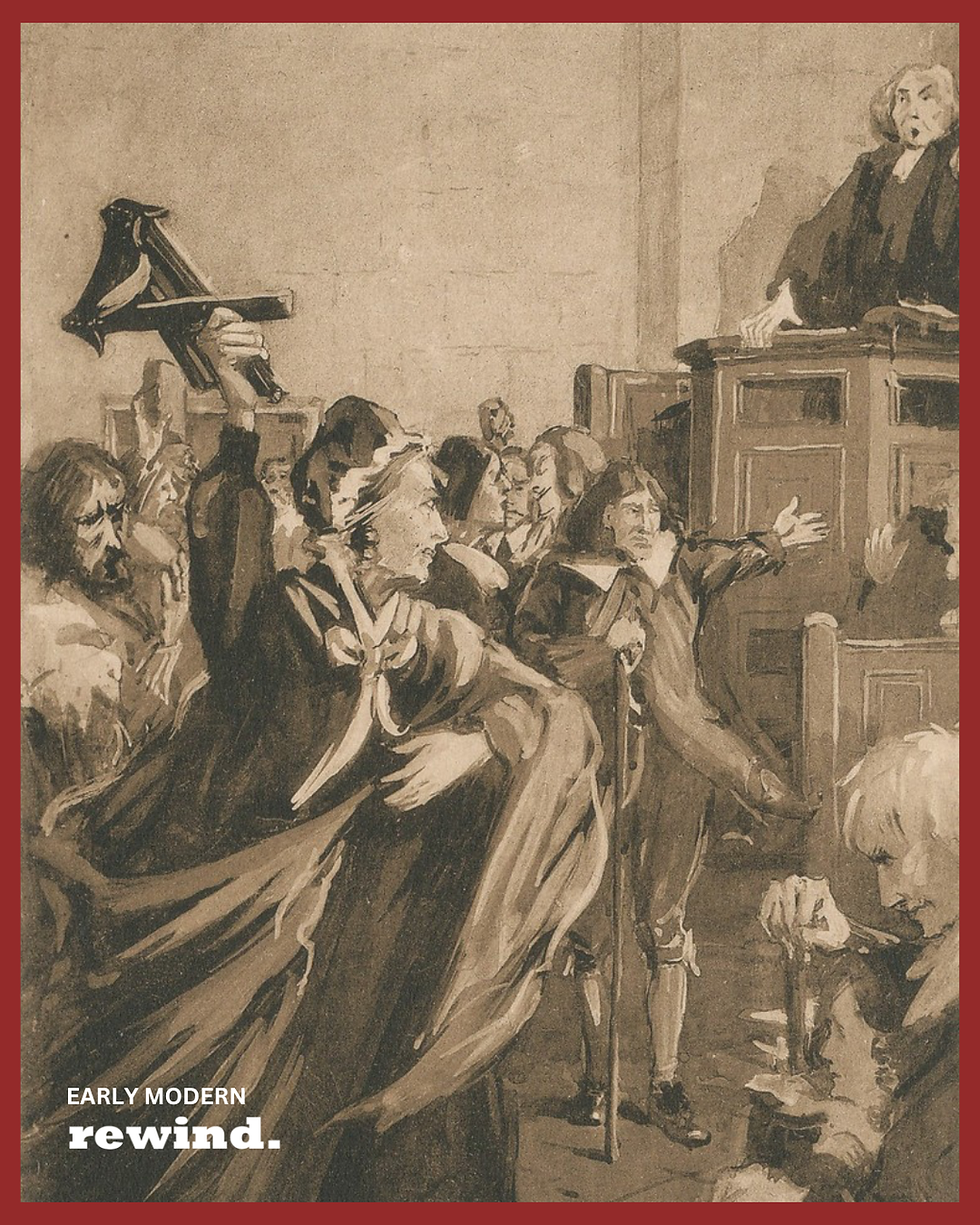
One ‘Jenny Geddes’ came to embody the rebellious Scottish spirit. On 23rd July 1637, the Dean began to read from the Book of Common Prayer at St Giles’ Cathedral, Edinburgh. Geddes is said to have thrown a stool at him, shouting he had no right to speak Mass to them. Stewart describes the riot as having a ‘vanguard’ of ‘waiting maides [sic] and women’. Geddes was being mythologised as early as 1651, and action at St Giles’ sent shockwaves across Scotland, with similar disturbances erupting in Glasgow in August.
Scholars generally believe that women were given freedom to act as Jenny did, based on contemporary accounts of the scale of their protesting activity and English contemporary propaganda which drew attention to female action as a means to discredit the movement. However, Stewart reveals that Covenanters ‘lamented’ the violence of women who sometimes shed blood. The women had to be creative. They applied deeply embedded European traditions of ‘charivari, carnival, and rituals of misrule’ to validate their involvement. Legendary figures like Geddes embodied these traditions to empower the weakest subject to act against Charles’ reforms.
The National Covenant was signed in February 1638. These ‘Covenanters’ aimed to defend the Presbyterian Scottish Kirk and keep it independent from the Anglican Church of England against the King’s will. Due to the widespread support for the document, copies were printed at every scale, from almost two metres high on expensive vellum to handheld paper copies distributed to each parishioner. Some Covenanters revered their personal copies with the same respect they held for the Bible – George Leslie bound together the 1638 National Covenant, 1643 Solemn League and Covenant, and the 1648 renewal in a little book ‘embossed with his initials’, keeping his copy free from annotation. Other people created miniature covenanting communities, having their friends and family sign a small paper copy – quiet acts of everyday resistance against Charles’ will.
Covenanters raised an army to defend the National Covenant when Charles did not accept its meaning. The King amassed his own army to suppress the rising and was unsuccessful in both the stand-off of the First Bishops’ War and the Battle of Newburn in 1640. The Covenanters had early military success. Scholars disagree about when the Covenant movement ended, the end date of Stevenson’s The Scottish Revolution being 1644, whilst Young’s article stops at 1651. Kennedy made a compelling case that the spirit of the movement necessarily continued until the 1689 Toleration Act, which marked a break from the Anglican monopoly. Whether or not the movement ended in the seventeenth century, it certainly declined after toleration was introduced.
Bibliography
Eire, Carlos, ‘Calvinism and the Reform of the Reformation’, (ed. Peter Marshall) in The Oxford Illustrated History of the Reformation (OUP, 2015)
Kennedy, Allan, ‘The Legacy of the Scottish Covenants and the Shaping of the Restoration State’, (ed. Chris R. Langley) in The National Covenant in Scotland: 1638-1689 (Boydell & Brewer, 2020)
Stevenson, David, The Scottish Revolution 1637-1644: The Triumph of the Covenanters (Newton Abbot: David and Charles, 1973)
Stewart, Laura A. M. Rethinking the Scottish Revolution: Covenanted Scotland, 1637-1651 (OUP, 2016)
Young, John R. ‘The Scottish Covenanters and the Drive for a Godly Society, 1639-1651’ in Recherches Anglaises et Nord Americanines, 40, (2007)


Comments