Lucio Fontana and Dimensionality
- Venetia di Montorio-Veronese
- Mar 17
- 8 min read

Fontana was a sculptor, painter and visionary artist. He was born in Rosario de Santa Fe, Argentina in 1899 to Italian parents. At the age of six he moved to Italy, where he later studied at the Brera Academy in Milan. He began his artistic career as a sculptor, initially working alongside his father, before developing his own independent practice throughout the 1930s.
In his own words, he did not want to be a painter, he did not want to be a sculptor, he wanted to be a spatial artist. He was deeply interested in the relationship between light and space and how these can work in unison to create ground breaking contemporary works. This exploration of light and spatial perception became a central theme throughout his life and is reflected in his oeuvre. Although he was inspired by futurism, Fontana ultimately moved beyond it, establishing a new artistic movement known as Spazialismo or Spatialism.
During the Second World War, Lucio Fontana left Italy and returned to his native Argentina. Although he continued to work across multiple media, including sculpture and ceramics, he later remarked that Argentina felt less inspiring compared with the dynamic artistic atmosphere of Europe. It was during this period in Argentina that Fontana wrote Manifesto Blanco in 1946, a theoretical text that first outlined the principles of Spatialism.
The manifesto can be characterised as a call for the synthesis of the arts, for an art that would be ‘a sum of physical elements - colour, sound, movement, time, space - which completes a physical-psychic unity.' In this sense, it calls upon a new form of art that incorporates the dynamic principle of movement through space and time, described as ‘the construction of voluminous forms changing through a plastic, mobile substance.’ The manifesto adopts an avant-garde position by advocating a collaboration between art and science. Fontana argued that this new approach would allow art to move beyond the flat canvas and engage directly with real space, reflecting the technological transformations of the post-war and space-age world.
It laid the groundwork for his later works, particularly the iconic, white, monochromatic and perforated canvases such as the slash series of the 1950s and 60s. These works were significant because they anticipated a shift toward a more cosmic understanding of reality.
Fontana went on to publish five additional manifestos that continued to advocate for a more expansive concept of art, incorporating the dimensions of space and time. This led to works that used neon lighting as well as experimentations with television broadcasting.
When Fontana returned to Milan in 1947, he discovered that his studio and many of his artworks had been destroyed by allied bombings. Interestingly, he did not experience this loss as traumatic. Instead, Fontana interpreted the destruction as a renewal: a symbolic new beginning not only for his own practice, but also for humanity more broadly. This moment served as a catalyst for his post-war artistic direction. In 1947 he formally launched the Spatialism movement, and by 1949 he began producing his first buchi ‘holes’ works, in which the surface of the canvas was punctured.
Breaking the Surface: The Buchi
Fontana’s decision to pierce the canvas represented a radical shift in modern art. By puncturing the canvas, he broke through the traditional two-dimensional plane of painting (unprecedented and unheard of at the time), opening a new dimension and a galaxy of opportunities beyond.
Rather than treating the canvas as a closed surface, Fontana opened it up to real space. This act did not aim to destroy the painting. Instead, Fontana intended to reveal what lay beyond the canvas. The punctures introduced a new sense of vitality and energy while transforming the work into an exploration of real space.
New Dimensionality: Ambienti Spaziali
Fontana’s spatial investigations extended beyond painting and sculpture into immersive environments. Through his Ambienti Spaziali or Spatial Environments, he sought to transform space itself into a direct sensory and psychological experience for the viewer.
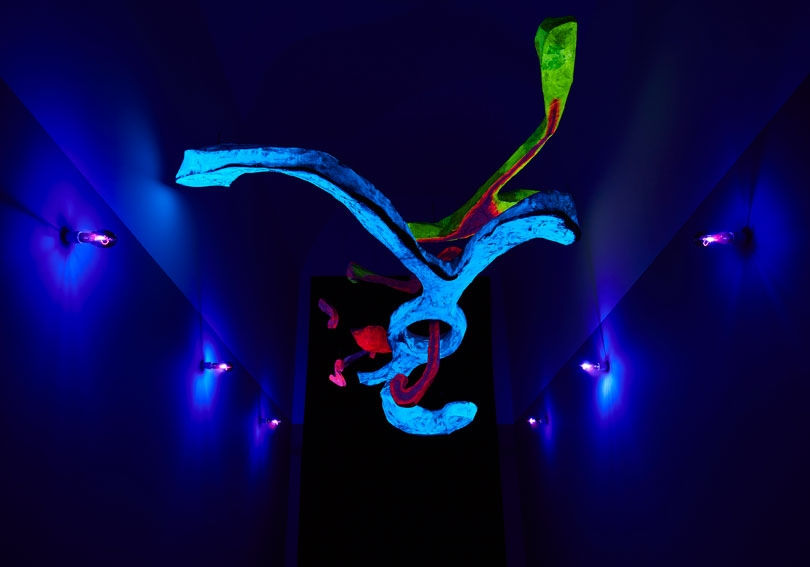
In 1949, he installed his first environment, Ambiente Spaziale a luce nera (spatial environment in black light) at the Galleria del Naviglio in Milan. It was an exhibition of floating forms illuminated by ultraviolet ‘black light’. The gallery space was darkened, and the phosphorescent colours of the suspended forms glowed under the ultraviolet lighting. This innovative use of light created an entirely new visual experience, no one had attempted to do this before, dissolving the boundaries between sculpture, architecture and environment.
Neon and the Expansion of Space
Fontana continued these spatial experiences with Struttura al neon per la IX Triennale di Milano (Neon Structure for the 9th Milan Triennial), created in 1951. The work consisted of a long neon tube suspended above the central staircase of the Palazzo dell’Arte during the Milan Triennial.

The glowing, looping form stretched through the architectural space, transforming the staircase into a dynamic visual experience. Critics at the time described it variously as a lasso, an arabesque or even a piece of spaghetti, but Fontana disliked this simplistic interpretation. For him, it was “not a lasso, an arabesque, nor a piece of spaghetti”, the work represented something far more significant “it is the beginning of a new expression; in collaboration with the architects Baldessari and Grisotti we have substituted for the decorated ceiling a new element which has entered into the aesthetic of the man on the street, neon, by this means we have created a fantastical new decoration.”
Neon had rarely been used in contemporary art at the time, and its luminous quality allowed Fontana to literally “draw in space”. The installation suggested a future shaped by technology, electricity and new spatial possibilities.
The Slash: Concetto Spaziale
By the 1950s, Fontana developed the gesture that would become his most iconic: the slash. These works, titled Concetto Spaziale or Spatial Concept, feature clean cuts across monochrome canvases. Among the most famous examples is Concetto Spaziale, Attese, created in 1964. Early versions contained multiple cuts, while later works often feature a single, carefully controlled incision. The word Attese means ‘expectations’ or ‘waiting’, suggesting that the cut acts as a threshold or doorway into infinite space. Fontana described the repeated gesture of slashing the canvas as similar to a musician repeating movements across a piano keyboard. The rhythm of the cuts can therefore be understood as a kind of visual composition, almost like a musical score.
Although the gesture may initially appear violent, the result is surprisingly calm and harmonious. Fontana insisted that the slash was not destructive but exploratory. It was a way of moving beyond the physical limitations of the canvas and opening it to the infinite.
Fontana often wrote short phrases on the reverse side of his canvases. These inscriptions sometimes served to authenticate the works, but they also reveal moments of humour or introspection. On one painting he wrote “sono stanco” meaning “I am tired”. The phrase could suggest an existential fatigue, but it might also be an ironic comment as slashing a canvas required very little physical effort.

Despite the simplicity of the gesture, Fontana believed the act carried profound meaning. As he explained: “When I sit before and contemplate one of my slashes, I suddenly feel a great relaxation.. I feel myself freed from the slavery of matter.” For Fontana, the slash represented liberation from material constraints and a connection to the vastness of the present and the future. His work reflects a deep belief in human intelligence and humanity’s place within the cosmos.
La fine di Dio
One of the culminating moments of Fontana’s career was the series La Fine di Dio meaning The End of God, created between 1963 and 1964. The series consists of thirty-eight large oval canvases covered with richly textured surfaces and punctured with holes. The oval shape evoked cosmic imagery, planets, eggs, or celestial bodies and suggested themes of creation and rebirth. Through these works, Fontana explored the idea of modern humanity looking outward toward the universe.

These works were created before the Apollo 11 Moon Landing. Yet, Fontana’s art seems to anticipate humanity’s exploration of space. Man had not set foot on the moon, yet through his work Fontana metaphorically brings man there, foreshadowing mankind walking across its surface and creating new paths.
He believed that art and science should not be separated but understood as interconnected forces shaping the modern world. Fontana captures this synergy through the undulating surfaces of his paintings, which echo the uneven terrain of the moon itself, reinforcing the cosmic dimension of the series.
Venice and New York

In July 1961, the art collector and philanthropist Paolo Marinotti invited Fontana to participate in the exhibition Arte e Contemplazione at the Palazzo Grassi in Venice, along with Jean Dubuffet, Mark Rothko and others. For this exhibition, Fontana created a series of works inspired by the city of Venice. The canvases were covered in thick layers of gold paint, referencing both the splendour of Venice's Byzantine heritage, visible in San Marco Basilica, and the luminous reflections of sunlight across the Venetian lagoon. Fontana also incorporated fragments of Murano glass into the surfaces, paying tribute to the city’s historic glassmaking tradition. These glass elements refract and redirect light, allowing the surface to shimmer and subtly guide the viewer’s gaze across the composition. Through the use of gold, silver and glass, Fontana sought to capture the unique radiance and opulence of the city.

His paintings received considerable acclaim and were later exhibited in a solo show organised by the gallerist Martha Jackson in New York. In November 1961, when Fontana flew to Manhattan for the exhibition, he was deeply mesmerised by the city, declaring that ‘New York is more beautiful than Venice’.
Inspired by its modern skyline, Fontana began experimenting with new materials upon his return to Milan. He worked with sheets of aluminium and copper, whose reflective surfaces allowed him to capture the dynamism and brilliance of New York’s skyscrapers and illuminated streets. Fontana explained that the reflective metal surfaces allowed him to evoke ‘orgies of light’ and the shimmering grid of glass windows across the city’s architecture. By scratching, piercing and slashing the metal surfaces, Fontana translated the energy of the metropolis into abstract form. From the romantic abstraction of the old city of Venice, Fontana was lured into the new, entrancing and fierce promise of New York City.

Reception
Fontana’s work has been widely celebrated within the international art market. His iconic Concetto Spaziale, Attese, achieved £8.4 million at Sotheby's London in 2015. Similarly, Festival of the Grand Canal, part of his Venice series, sold for $7 million at Christie’s in New York in 2008. Fontana’s Concetta spaziale, La fine di Dio achieved an even higher price, selling for $29 million at Christie's New York in 2015 and setting a world auction record for the artist.
Together, these achievements confirm Fontana’s enduring influence as one of the most pioneering figures of post-war modern art.
Images
Fig 1. Ambiente Spaziale a luce nera, 1949
Fig 2. Struttura al neon per la IX Triennale di Milano, 1951
Fig 3. Concetto spaziale, Attese, 1964
Fig 4. La Fine di Dio, 1963-4
Fig 5&6. Concetto spaziale, Venezia era tutto d’oro, 1961
Concetto spaziale, In piazza San Marco di notte con Teresita, 1961 (part of his Venezia series)
Fig 7. Concetto spaziale, New York 10, 1962 (part of his metalli series)
Bibliography
Primary Sources
Fontana, Lucio, Manifesto Blanco (Buenos Aires, 1946).
Christie's, ‘Lucio Fontana’, lot 6435024, https://www.christies.com/en/lot/lot-6435024 [accessed 1 March 2026]
Secondary Sources
Estorick Collection of Modern Italian Art, 'Lucio Fontana: At the Roots of Spatialism', https://www.estorickcollection.com/exhibitions/lucio-fontana-at-the-roots-of-spatialism [accessed 1 March 2026].
Lucio Fontana: Ten Paintings of Venice (New York: Martha Jackson Gallery, 1961).
Museo Nacional Thyssen-Bornemisza, Ventanas al arte contemporáneo 7: Lucio Fontana, https://www.museothyssen.org/sites/default/files/document/2023-03/Ventanas7_eng_Olmedo_Fontana.pdf [accessed 1 March 2026]
Phillips, ‘Lucio Fontana, Concetto spaziale’, https://www.phillips.com/detail/lucio-fontana/186235 [accessed 1 March 2026].
Solomon R. Guggenheim Foundation, ‘Lucio Fontana: Venice / New York’, https://www.guggenheim.org/exhibition/lucio-fontana-venicenew-york [accessed 1 March 2026]
White, Anthony, ‘Lucio Fontana: Between Utopia and Kitsch’, Grey Room, 5 (2001), 55–77, http://www.jstor.org/stable/1262573 [accessed 1 March 2026]


Comments