Did You Know That There’s a Layer of Burned Debris Under Colchester, London and St. Albans?
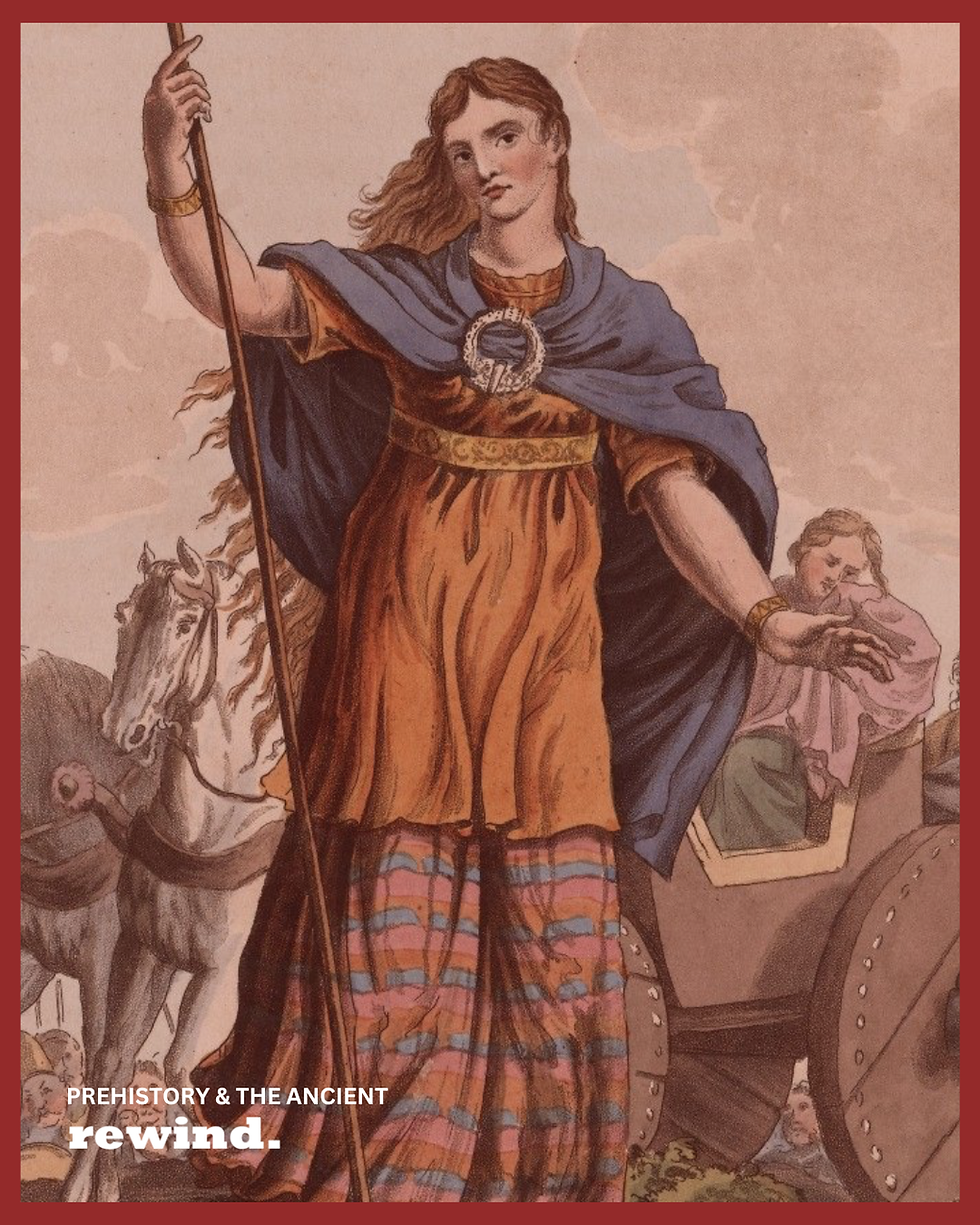
In 60/61 CE, Boudica, queen of the Iceni, led a revolt that unleashed devastation upon the early Roman settlements in Camulodunum, Londinium and Verulamium. With no voice of her own in the historical record,our knowledge of the revolt and the woman herself comes from Roman writers and what was left behind in Colchester, London and St. Albans.
Textual evidence for Boudica’s revolt comes from Publius Cornelius Tacitus and Lucius Cassius Dio, Roman historians writing about Boudica some forty and one hundred and forty years after the revolt.Considering their distance from the events, it is notable that Tacitus may have had access to a first-hand account, as his father-in-law Gnaeus Julius Agricola had taken part in the suppression of the revolt.
Tacitus and Dio disagree on whether the revolt was based upon the enslavement of the Iceni, or a dispute over a monetary loan. However, the historians concur on the Iceni’s descent upon Camulodunum and Londinium; the destruction unleashed; and that they took no captives. Tacitus adds that she undertook similar actions in Verulamium, which Dio fails to mention.
Tacitus and Dio’s accounts have been incredibly influential in the archaeology of early Roman Britain, especially in the south-east of England. So much so that evidence of burnings and assorted acts of vandalismin this region and era has been linked to Boudica’s revolt by default. However, archaeologists have found the strongest evidence of Boudica’s revolt, in the form of a layer of burned debris lying in the stratigraphy ofColchester, London and St. Albans, dated to 60/61 CE.
This is most clearly exemplified in Colchester. During 60/61 CE, Camulodunum was a new town with no defences, serving as the religious centre for the province. From the varying depths of the layer, archaeologists can infer dynamic levels of fire damage faced by the Roman settlements. The coins, glass and pottery fragments found beneath the burned debris indicate the swiftness of the fire, consuming buildings before people could return to retrieve their belongings. The town was rebuilt atop this layer of burned debris, except for the temple of Divus Claudius, of which the burned material was completely removed, possibly through a ritual cleansing.
Beyond the physical record, the textual sources reveal as much about Roman attitudes as they do about the revolt itself. Tacitus and Dio’s writing flatters the Roman soldiers stationed in Britain, contrasting their discipline and military prowess with the local Britons. As texts, The Annals and Roman History chronicle large sweeps of Roman history, of which Boudica’s revolt is little more than a few chapters. While Tacitus and Dio disagree over key facts of the revolt, they are certain of the woman who led it: Boudica.
Boudica’s leadership and her tolerance for women fighters stand out to Tacitus and Dio. Dio is particularly embarrassed that Romans were massacred by a woman, calling it ‘a fact which itself caused them a great shame’. Meanwhile, Tacitus remarks on the strength of the Romans who ‘gave no quarter even to women’.
Given this, the revolt was evidently a major threat to the Roman presence in Britain. Both authors describe Britain’s Governor, Gaius Suetonius Paulinus’ quick turnaround from the island of Mona to meet Boudica in the field after her force’s destruction of Camulodunum and Londinium. Boudica's legacy lives on, written into the historical record and burned into the ground beneath three Roman cities.
Bibliography
Primary sources
Dio, Lucius Cassius, Roman History, ed. Bill Thayer, trans. Earnest Cary, 9 vols (Loeb Classical Library, 1925) < https://penelope.uchicago.edu/Thayer/E/Roman/Texts/Cassius_Dio/62*.html> Accessed 27 February 2026
Hull, M.R. “Roman Colchester”, Reports of the Research Committee of the Society of Antiquaries of London, XX (Society of Antiquaries of London, 1958)
Tacitus, Publius Cornelius, The Annals, ed. Bill Thayer, trans. by J. Jackson, 5 vols (Loeb Classical Library, 1937) < https://penelope.uchicago.edu/Thayer/E/Roman/Texts/Tacitus/Annals/14B*.html> Accessed 27 February 2026
Secondary sources
Hingley, Richard and Christina Unwin, Boudica: Iron Age Warrior Queen (Hambledon Continuum 2006)


Comments